
Scaling Modern Corporate Capacities With Specialized Commercial Mechanical Systems
June 29, 2026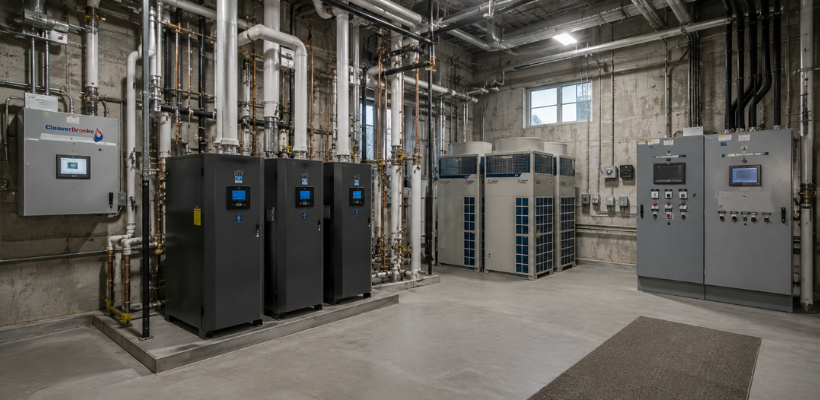
As Canadian enterprises evolve to meet higher production volumes and stricter environmental regulations, operational capacity is no longer defined solely by square footage. Instead, it is dictated by the resilience and efficiency of the infrastructure that conditions the indoor environment. Investing in advanced commercial mechanical systems represents a strategic lever for scaling operations without proportionally scaling maintenance costs or energy liabilities.
Many facility managers assume legacy equipment can be pushed further with reactive repairs. While this sustains short-term output, the journey from the mechanical room to the production floor introduces variables that erode profitability. Aged air handlers, undersized boilers, and unintegrated automation create thermal imbalances and unpredictable utility spikes. A professional-grade retrofit reconfigures the entire energy and airflow architecture of a commercial asset, protecting your workforce, inventory, and bottom line.
Understanding the Load Profile of Growing Canadian Enterprises
The Canadian climate presents unique demands that generic system designs fail to address. From the humidity of a southern Ontario summer to -30°C Prairie cold snaps, commercial buildings must respond to dramatic external swings while maintaining internal stability. Furthermore, post-pandemic occupancy patterns have permanently altered load calculations.
When a commercial space is expanded, existing mechanical infrastructure often operates outside its design parameters. Common failure modes include short-cycling compressors, air stratification in warehouses, and positive pressurisation that forces untreated outside air through envelope gaps, raising energy costs by 18 to 22 per cent.
Specialized commercial mechanical systems diagnose and correct these failure modes at their source, right-sizing compressors and rebalancing airflow with variable frequency drives that modulate energy use precisely to real-time demand.
The Case for Decentralised and Modular Architectures
Traditional central plant designs present a single point of failure. When that central unit requires maintenance, an entire facility may halt operations. For scaling enterprises, this risk is unacceptable. The modern alternative is a decentralised, modular architecture.
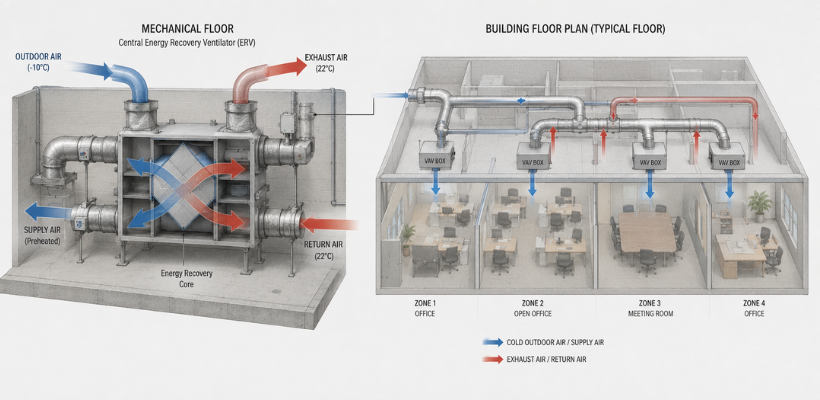
For commercial buildings across Canada, an integrated modular system typically combines decentralised heat pumps with energy recovery ventilators (ERVs). Each zone operates independently, yet all units communicate through a building automation system. If one module requires service, the remaining units continue to operate at reduced but functional capacity.
Key advantages of modular commercial mechanical systems:
- Redundant capacity ensures continuous operation during maintenance.
- Precise zone control eliminates the “one temperature fits all” compromise.
- Scalable installation allows modules to be added as operations expand.
- Simplified maintenance with smaller, accessible individual components.
A properly configured modular system also protects your building envelope by eliminating the thermal stress caused by large central units cycling on and off.
High-Performance Filtration as a Productivity Asset
Post-2020 commercial strategies have elevated indoor air quality (IAQ) to a core business metric. Poor IAQ correlates directly with increased sick leave and reduced cognitive function. Specialized commercial mechanical systems now integrate MERV-13 or HEPA filtration, ultraviolet germicidal irradiation, and bipolar ionisation to manage airborne particulates and biological contaminants.
For a Canadian corporate office or medical clinic, an upgraded IAQ strategy delivers measurable returns. The filtration train captures particles down to 0.3 microns. Ultraviolet lamps neutralise microorganisms, and bipolar ionisation agglomerates sub-micron contaminants for subsequent capture.
For authoritative information on Canadian indoor air quality guidelines, including ventilation rates for commercial buildings, review the resources provided by the Government of Canada.
Professional Integration Versus Retrofit Kits
The low-bid contracting market offers packaged mechanical solutions, but these carry significant risks. Most off-the-shelf rooftop units use single-stage compressors that create temperature swings of up to 3°C. Improperly configured automation can also create control conflicts, leading to simultaneous heating and cooling.
One Mechanical approaches commercial design as an integrated engineering problem. Our technicians model the specific heat gain and occupancy schedules of your Canadian facility before specifying equipment. We install isolated control loops and remote monitoring portals for real-time verification. Professional integration ensures compliance with the Ontario Building Code and the National Energy Code of Canada for Buildings.
The Financial Return on Mechanical Precision
The transformation delivered by Specialized systems translates directly into financial statements. Utility costs decline by 25 to 35 per cent annually. Equipment that would otherwise last 12 years operates efficiently for 18 years or more.
Conclusion
For growing Canadian enterprises, our natural climate extremes mean legacy equipment constantly works against your productivity and asset value. Advanced commercial mechanical systems represent a deliberate recalibration of your operational environment. One Mechanical provides the engineering expertise, certified equipment, and ongoing support to transform your mechanical infrastructure from a source of recurring failures into a platform for reliable, scalable growth. Contact us to schedule a load assessment.